What Is Programming? Why Everyone Should Learn It ?
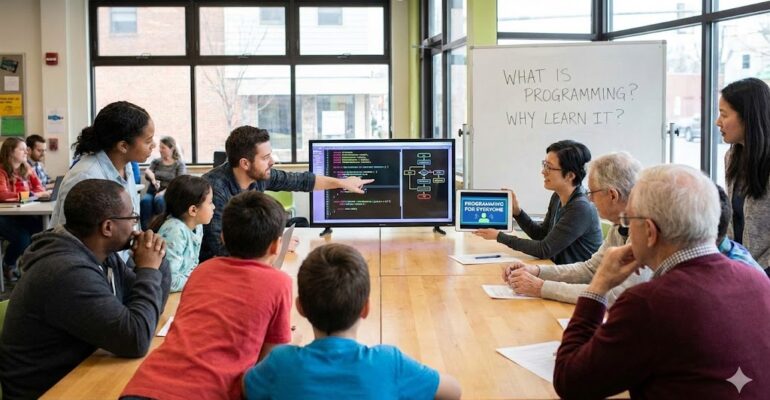

Confused by code? Discover what programming actually is in simple terms. Learn the surprising benefits of coding skills for your career and daily life even if you aren’t a techie.
Look around the room right now. Chances are, almost everything powered by electricity, from the smartphone in your pocket to the microwave in your kitchen and the car in your driveway, runs on code. We live in a world built by software. Yet, for most people, the concept of “Programming” seems like dark magic performed by hooded figures typing green text onto black screens at tremendous speeds. It’s time to demystify the process. Programming isn’t just for software engineers at Google or Facebook. It is becoming a fundamental literacy skill of the 21st century.

Here is a breakdown of what programming actually is, and why learning the basics is one of the best investments you can make in yourself.
What Actually is Programming?
At its simplest level, Programming is the act of giving a computer a set of instructions to perform a specific task.
Computers are incredibly fast and powerful, but they are also surprisingly “dumb.” They have zero intuition. If you tell a human to “make a peanut butter sandwich,” they know to get the bread, open the jar, and use a knife. If you tell a computer that without explicit steps, it will crash.
Programming is the bridge between human intent and machine action.
In programming, you are writing a recipe for the computer. But instead of ingredients, you are using data. And instead of “stirring,” you are using commands like “calculate,” “display,” or “store.”
What About “Coding Languages”?
You can’t just speak English to a computer. You have to use a language it understands. These are called programming languages. Just like human languages (English, Spanish, Mandarin), different programming languages are used for different things:
- HTML & CSS: The skeleton and paint of websites (what you are looking at right now).
- JavaScript: Makes websites interactive (like buttons that change color when you click them).
- Python: Great for beginners, data science, and artificial intelligence.
- Java & C++: Often used for building large enterprise software, games, and mobile apps.
“Coding” is simply the act of writing these instructions in one of these languages.
Why EVERYONE Should Learn the Basics (Even Non-Techies)
You might be thinking: “I work in marketing/HR/healthcare/finance. I have no desire to be a software developer. Why should I care?”
This is the biggest misconception about programming. You don’t learn to write to become a professional novelist; you learn to write to communicate. Similarly, you don’t learn to code just to become a developer.
Here are the universal benefits of learning programming fundamentals:
1. It Teaches “Computational Thinking”
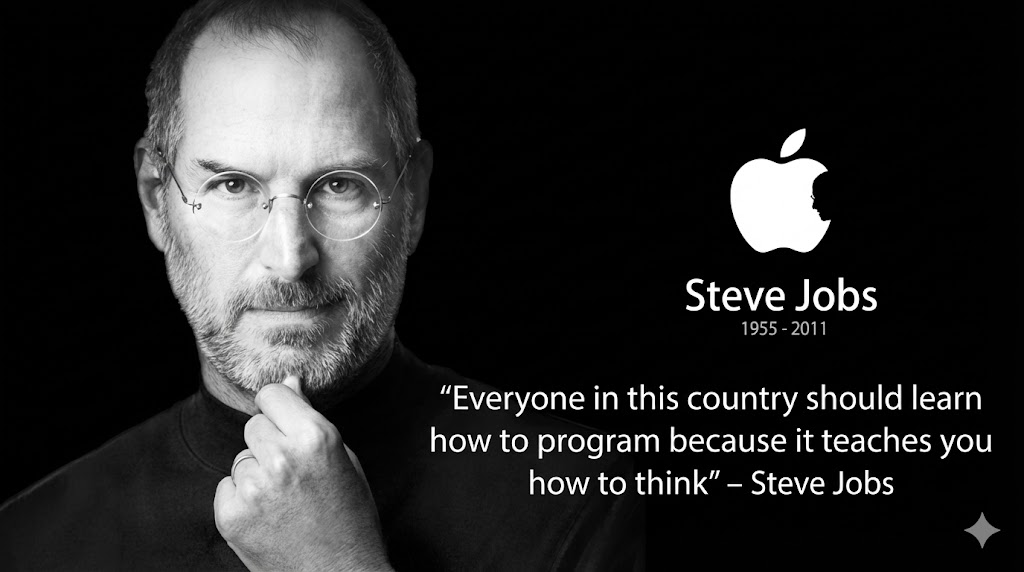
Steve Jobs once said, “Everybody in this country should learn how to program a computer… because it teaches you how to think.”
Learning to code forces you to break down complex, overwhelming problems into small, logical, manageable steps. This is called computational thinking. It is a problem-solving methodology that applies to almost any area of life, from organizing a complex event to managing household finances.
2. You Can Automate the Boring Stuff
Do you spend hours every week copy-pasting data between Excel spreadsheets? Do you manually rename hundreds of files? A tiny bit of coding knowledge (perhaps in Python or VBA) allows you to write simple scripts that automate these tedious, repetitive tasks. What used to take you five hours could take a script five seconds. That is a superpower in any office job.
3. It Improves Communication with Tech Teams
Today, almost every company is a “tech company” to some degree. If you work in marketing, you need to talk to web developers. If you are a product manager, you need to understand engineering constraints. Knowing the basics of programming, understanding what an API is, or the difference between front-end and back-end, makes you infinitely more valuable because you can bridge the gap between technical and non-technical teams.
4. It Unleashes Creativity
Programming is inherently creative. It’s the closest thing we have to digital LEGO bricks. Once you know the basics, you can build a personal website to showcase your portfolio, create a simple mobile app for your local community group, or design a basic game. It turns you from a passive consumer of technology into an active creator.
Busting the Myths Keeping You From Starting
If programming is so great, why doesn’t everyone do it? Usually, fear and misconceptions hold people back.
Myth #1: You need to be a math genius. Reality: Most day-to-day programming requires nothing more than basic arithmetic and perhaps some high school algebra. Logic is far more important than advanced calculus.
Myth #2: You need a Computer Science degree. Reality: The tech industry is increasingly prioritizing skills over degrees. Many successful professionals taught themselves using online resources, bootcamps, or community college courses.
Myth #3: It’s too late to learn. Reality: People successfully learn to code in their 30s, 40s, 50s, and beyond. The tools for learning have never been more accessible or beginner-friendly than they are right now.
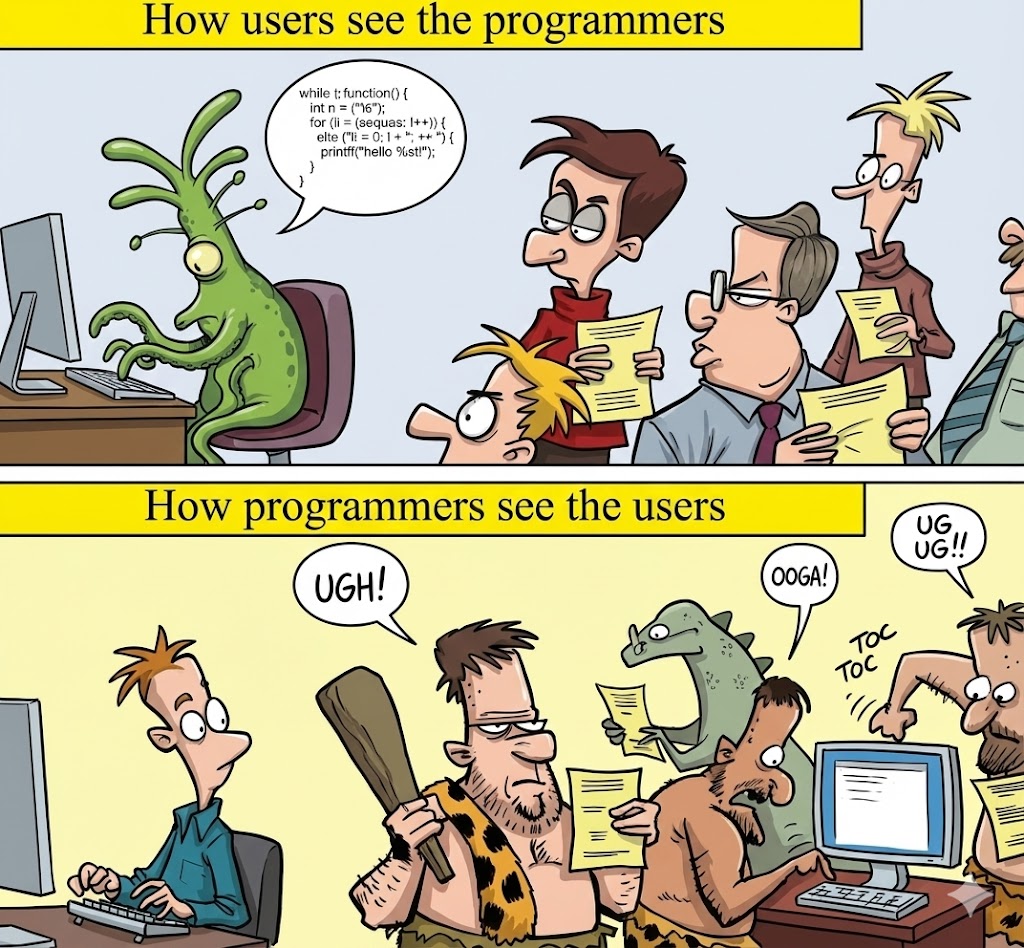
The New Literacy
Reading and writing used to be specialized skills for scribes and scholars. Today, they are essential requirements for functioning in society. We are rapidly approaching a point where a basic understanding of programming, digital literacy, will be viewed the same way. You don’t need to become an expert. But understanding the “how” behind the technology that runs our world is no longer optional, it’s empowering.
Don’t let the jargon intimidate you. Start small. Try a free introductory course online. You might just find that speaking the language of computers is easier, and more rewarding, than you imagined.